Neptune DXP - Open Edition life cycle
Neptune DXP - Open Edition has been available since June 2018. The name has changed over this time.
The life cycle of a version begins with the release and ends when the new version is no longer supported.
Knowing this life cycle helps you make informed decisions about when to upgrade or make other changes to your landscape.
Release train model
Neptune DXP - Open Edition’s release life cycle follows a release train model that ensures the delivery of releases according to a structured and recurring release cadence. The release train model enables regular delivery of incremental improvements and establishes long-term stability through explicitly defined maintenance and support windows.
Semantic versioning
Neptune DXP - Open Edition releases follow the semantic versioning (SemVer) methodology:
MAJOR.MINOR.PATCH
-
MAJOR: Introduces breaking changes to the platform.
-
MINOR: Delivers routine feature releases without breaking existing functionality.
-
PATCH: Supplies safe bug-fix updates and small corrections.
In the context of the Neptune DXP - Open Edition release train model, semantic version numbers indicate compatibility impact only and are not used to express feature stability/maturity, or support duration.
Where breaking changes are introduced as a result of internal architectural
changes or external dependency updates, a release may be published as a new major
version, even if it follows a regular minor-release cadence (for example, 24.16.0 → 25.0.0).
|
Support designation
At its discretion, Neptune applies two support designations to minor releases (or major releases in the event of breaking changes) produced by the release train to classify maintenance scope and support duration in accordance with the Maintenance and Support Agreement:
-
Medium-Term Support (MTS)
-
Long-Term Support (LTS)
Each support designation includes a defined support window, ensuring you always know which versions are maintained, how long a version receives fixes, and when to plan upgrades.
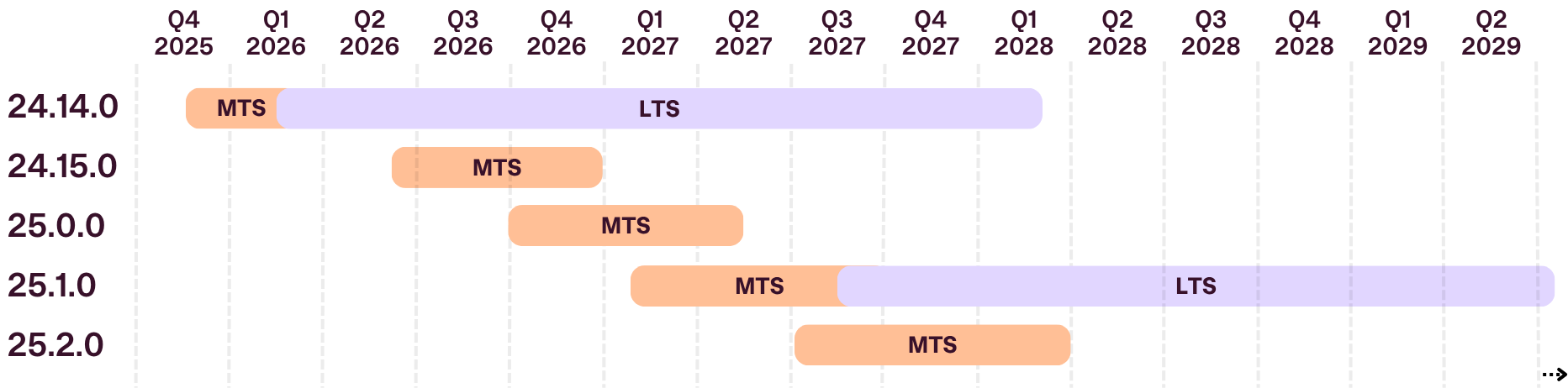
The following table summarizes the support designations applied to minor releases within the Neptune release train. Each minor release is initially classified as a release with Medium-Term Support (MTS) by default.
Certain minor releases with Medium-Term Support (MTS) may later be designated as Long-Term Support (LTS) once they have demonstrated sufficient maturity and stability. Support windows, delivery cadence, and transition rules are defined independently of semantic versioning and release timing.
Patch releases of respective MTS and LTS support designations follow the support window of the corresponding minor release with either MTS or LTS support designation.
| Support designation | Support designation logic | Purpose | Support window | Delivery cadence | Notes |
|---|---|---|---|---|---|
Medium-Term Support (MTS) |
Default classification for all minor releases |
Deliver incremental features and continuous innovation between minor releases with LTS designation |
Ends 3 months after the next minor release with MTS designation |
Aim to release ~3 yearly minor versions that start with MTS support designation |
Subsequent LTS designation of later releases does not modify MTS support period |
Long-Term Support (LTS) |
Transition from MTS when release reaches maturity and stability (typically after ≥1 patch) |
Serve as a stable baseline within the release train |
Begins at release and continues until the second subsequent minor release designated as LTS |
Aim to designate maximum 1 minor release with MTS support designation per year as LTS |
Overlapping support windows ensure continuous availability |
|
Choose a minor release with MTS support designation to get all the latest features in Neptune DXP - Open Edition. If you require support for features from a minor release with MTS support designation beyond the MTS support window, you must upgrade to the next compatible version release. Choose a minor release with LTS support designation for maximum stability of tested features. Newest features from subsequent minor releases with MTS support designations are not included until you upgrade to the minor release with LTS support designation. |
Current Neptune DXP - Open Edition maintenance status
| Version | Support | Released | Designated LTS | Maintenance status | End of maintenance |
|---|---|---|---|---|---|
DXP 24.14.0 |
LTS |
December 2025 |
January 2026 |
Maintenance |
Q1/2028 |
DXP 24.12.0 |
MTS |
May 2025 |
N/A |
Out of maintenance |
June 2026 |
DXP 24.11.0 |
MTS |
March 2025 |
N/A |
Out of maintenance |
November 2025 |
DXP 24.10.0 |
LTS |
Q4/2024 |
N/A |
Out of maintenance |
September 2025 |
DXP 23 |
LTS |
Q4/2023 |
Q4/2023 |
Maintenance |
Q4/2026 |
DXP 22 |
LTS |
Q4/2022 |
Q4/2022 |
Out of maintenance |
Q4/2025 |
DXP 21 |
LTS |
Q4/2021 |
Q4/2021 |
Out of maintenance |
Q4/2023 |
Release forecast
The following table illustrates upcoming releases within the Neptune release train. Version numbers follow semantic versioning, while support designations are applied independently. All minor releases are classified as Medium-Term Support (MTS) at release. Selected releases may later be designated as Long-Term Support (LTS) based on demonstrated maturity. LTS designation is applied post-release and does not affect release cadence.
| Version | Planned release quarter | Initial support | LTS designation (post-release) |
|---|---|---|---|
24.14.0 |
Q4 2025 |
MTS |
Yes |
24.15.0 |
Q2 2026 |
MTS |
— |
25.0.0 |
Q3 2026 |
MTS |
— |
25.1.0 |
Q1 2027 |
MTS |
Yes |
The versions shown in the table represent planned minor releases. If compatibility-breaking
changes are introduced due to internal evolution or external dependency constraints,
Neptune may, at its discretion, promote the affected release to the next major
version (for example, 24.16.0 → 25.0.0). In such cases, subsequent version
numbering is adjusted accordingly. This does not affect the release train cadence
or the MTS/LTS support designation principles.
|
Documentation version scope
Neptune DXP - Open Edition documentation is published in alignment with the release train model and reflects the functional scope of each release:
-
LTS documentation sets aggregate all applicable changes introduced across the support window between two LTS designations.
-
MTS documentation sets describe the incremental changes introduced by the respective innovation release.
-
The most recent MTS documentation is published independently once the release becomes available.
For example, the 24.14 LTS documentation includes cumulative changes introduced
since the previous LTS release (24.10 LTS), whereas the 24.15 MTS documentation
is published as a standalone MTS set describing that release only.